This post contains affiliate links. If you purchase through one of these links, we may earn a small commission at no additional cost to you.
Music can make a quiet morning feel warmer, a favorite podcast can keep us company while we cook, and a familiar album can help us settle down after a busy day. Yet listening at home is not always as enjoyable as it could be. Voices may sound muffled, bass may overwhelm a small room, or a perfectly good speaker may seem disappointing simply because it sits in an awkward spot.
The good news is that better sound does not have to involve a large stereo system, a pile of remotes, or an expensive shopping list. Sometimes the most useful improvement is moving a speaker, adjusting a setting, or adding a small accessory that helps the equipment you already own work better.
At Nettie’s Nick Nacks, we appreciate practical changes that make everyday life a little easier. These five simple ways to improve your home listening experience start with what you have and build toward thoughtful upgrades only where they serve a purpose.
Give Your Speakers a Better Place to Sit
A speaker often ends up wherever there is an empty shelf or a nearby outlet. That is convenient, but the location can affect what you hear. Tucking a speaker into a crowded bookcase, placing it behind decorations, or pushing it into a corner may leave music sounding uneven or overly heavy in the bass.
Start by giving the speaker a clear path toward the place where you usually listen. Move objects away from the front and check the manufacturer’s placement guidance, especially if the speaker has an opening on its back. There is no single wall distance that suits every model, so try moving it forward a little at a time and listening from your usual chair. A small adjustment may make bass sound less overpowering without losing the warmth you enjoy.
For a traditional pair of stereo speakers, begin with one on each side of your listening area, with roughly equal distances between each speaker and your seat. Position their high-frequency drivers, often called tweeters, near seated ear height when practical. Depending on the model, turning them slightly toward you may help bring voices into focus. Speaker design matters, so treat this arrangement as a starting point rather than a rigid rule.
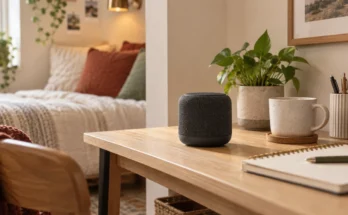
A single portable or smart speaker needs less planning, but it still benefits from an unobstructed location. Try it on a stable side table or an open section of a shelf instead of deep inside a cabinet. Use a familiar song to compare positions, keeping the volume similar each time. The goal is a spot that sounds good during the way you actually use the room.
Use Simple Accessories to Support Your Setup
Once you find a better location, a useful accessory can help keep the speaker there. Small desktop stands are especially handy when speakers sit beside a computer. Depending on their design, they lift or angle the speakers toward your ears while leaving a little more usable space on the desk.
Choose stands that fit the speakers’ dimensions and support their weight securely. A small portable speaker needs a different solution from a heavy bookshelf model, and an attractive stand is not much use if the speaker wobbles on top. For speakers beside a couch or across a living room, appropriately sized floor stands may make positioning easier when existing furniture is too low or too far away.
Isolation pads or stands with cushioning can also be useful if a speaker transfers vibration into a desk or shelf. Their effect depends on the speaker, furniture, and room; they will not transform every setup. Before buying anything, check for loose objects nearby. A picture frame, cabinet door, or set of keys may be responsible for the rattle you hear.
Cable clips and reusable ties are another modest improvement worth considering. They will not change the sound, but they can keep charging leads accessible and prevent cables from slipping behind furniture. A setup that is easy to use is more likely to become part of your day. Pick accessories that solve a specific annoyance, whether that is awkward speaker height, vibration, or a cable you have to retrieve every morning.
No products found
Try adjusting your search or filters
Make the Room a Little Friendlier to Sound
Your room is part of the listening experience. Bare floors, large windows, and other hard surfaces reflect sound, which can make some spaces feel noticeably echoey. If spoken voices sound sharp or seem to linger, the room itself may be contributing to the problem.
You do not need to turn your living room into a recording studio. An area rug over a hard floor, curtains at a window, or upholstered furniture can help absorb some reflected sound. Their effects vary with the materials and placement, and everyday furnishings generally do much less for deep bass than for higher-frequency reflections. Still, these are approachable changes that can make a room more comfortable while fitting naturally into its décor.
Before purchasing anything, compare listening with curtains open and closed, or try the speaker in a more comfortably furnished part of the room. These small experiments can help you decide whether the space is affecting your enjoyment. If bass is the main problem, return to speaker placement first rather than expecting a rug to fix it.
Background noise deserves attention, too. A dishwasher, television playing in another room, or noisy fan can make quiet details harder to hear. When convenient, give yourself a few minutes of quieter listening before reaching for the volume control. Moving closer to the speaker can also help, especially for podcasts and audiobooks. Clearer listening often comes from making the sound easier to hear at a comfortable level.
Adjust the Sound Settings You Already Have
Many speakers, televisions, and music apps offer sound controls that are easy to overlook. You may already have a useful adjustment available without needing another device.
Begin with a neutral setting, then change one thing at a time. If bass overwhelms voices, reduce it slightly. If the sound feels thin, a modest increase may make it more enjoyable. An equalizer, often shortened to EQ, adjusts different parts of the sound, but there is no universal setting that works for every speaker and room. Small changes are easier to judge than pushing every slider upward.
For television listening, look for a dialogue or speech setting if your equipment includes one. Try it during a familiar program and decide whether voices become easier to follow. Night mode, when available, may reduce the difference between quiet dialogue and loud effects, making evening viewing more comfortable. The exact behavior depends on the device, so check its description rather than assuming all modes work alike.
Some app-controlled speakers also offer room tuning that adjusts playback to suit their surroundings. If yours supports it, follow the guided setup after settling on the speaker’s location. You can then compare the result with tuning enabled and disabled.
Give each change a fair comparison at a similar volume. Louder sound can seem more impressive at first, even when it is not clearer. Keep the settings that improve the music or speech you actually enjoy, and leave the rest alone.
Choose One Affordable Upgrade That Fits Your Routine
If placement and settings still leave you wanting more, consider the part of your listening routine that needs help most. A focused purchase is easier to choose than a complete audio overhaul.
For music at a desk, a compact pair of powered speakers can be a practical option. Powered speakers have amplification built in, so they do not require a separate amplifier. You will still need power, a compatible connection to your computer or phone, and usually a cable linking the pair. Check those details before buying, especially if you prefer a wired connection or want simple physical volume controls.
For television, a basic soundbar may be a more useful upgrade. Look for easy controls and a connection that matches your TV, commonly HDMI ARC, HDMI eARC, or optical. A regular HDMI socket is not automatically an audio-return connection, so check the labels and both products’ instructions. Consider the space below the screen as well, making sure the soundbar will not block the picture or the TV’s remote sensor.
If you already enjoy a compatible wireless speaker, adding a matching speaker for a stereo pair may be another option. Confirm that the models support true left-and-right stereo pairing. The ability to play music on several speakers does not necessarily mean they can form a stereo pair.
Comfortable headphones may be the better choice for private evening listening or a shared home. Whatever you choose, favor the improvement you will use regularly. Easy connections, comfortable controls, and a suitable size often matter more in daily life than a long list of features.
Better Listening Starts with One Small Change
Improving your home listening experience can be a gradual process. Move a speaker, listen to something familiar, and see what changes. Then explore a setting, tidy a troublesome cable, or consider an accessory that supports a better arrangement.
The most satisfying setup is one that fits your room and makes it easy to enjoy what you love. With a few thoughtful adjustments, everyday music, podcasts, audiobooks, and television can become a more comfortable part of home life.
Looking for more simple technology that fits comfortably into everyday life? Visit our Listen collection for practical guides to speakers, headphones, and other audio products. You can also explore Nettie’s Nick Nacks to discover useful ideas for what you listen to, wear, carry, live with, and discover next.