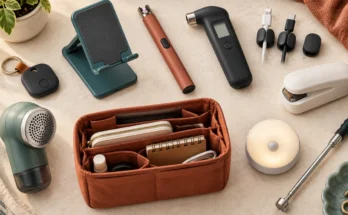
A good everyday tech pouch can make daily life a lot easier. Instead of digging through a backpack, purse, desk drawer, or glove compartment every time you need a charging cable or adapter, you can keep the small essentials together in one organized place.
The goal is not to carry every gadget you own. In fact, the best tech pouch is usually a simple one. A few carefully chosen accessories can cover most everyday situations without adding unnecessary bulk to your bag.
For most people, that means charging cables, a compact wall charger, earbuds, a portable power bank, a couple of adapters, and a few small accessories that solve common problems when you are away from home.
Start With a Pouch You Will Actually Carry
Before deciding what goes inside, choose a pouch that fits the way you normally travel. A large electronics organizer might look impressive, but it does not help much if it is too bulky to carry every day.
A small or medium pouch is usually enough. Look for something with a few internal compartments, elastic loops, or small zipper pockets. These features help prevent cables from becoming tangled and keep tiny adapters from disappearing into the bottom.
Soft-sided organizers tend to fit more easily into backpacks and tote bags, while semi-rigid cases provide a little more protection. Neither style is automatically better. The important thing is choosing the smallest pouch that comfortably holds the accessories you actually use.
Carry One or Two Useful Charging Cables
Charging cables should form the foundation of the pouch. For many people, USB-C will be the most useful option because it is now found on phones, tablets, earbuds, portable batteries, laptops, and many other devices. A good three-foot USB-C cable is long enough for most situations without taking up too much room.
If you regularly charge a laptop, check that the cable supports the wattage your computer requires. USB-C cables may look nearly identical, but they do not all support the same charging speeds. A second cable is also worth carrying. Depending on your devices, that might be another USB-C cable, a Lightning cable for an older Apple device, or even Micro-USB for older accessories.
You could also carry a compact multi-connector cable that includes several plug types. These are convenient for emergencies, although individual high-quality cables are often better for devices you charge frequently. There is no need to carry five cables. One primary cable and one backup usually provide enough flexibility.
Add a Compact Wall Charger
A charging cable is only useful when you have somewhere to plug it in, so a compact wall charger belongs in almost every everyday tech pouch.
Modern USB-C chargers can provide a surprising amount of power from a very small package. For phones, earbuds, tablets, and similar devices, something in the 30-watt to 45-watt range may be enough. Laptop users may need a more powerful charger depending on the computer.
A charger with two ports can also be useful because it allows you to charge multiple devices from one outlet. That becomes especially convenient in hotels, coffee shops, offices, airports, and other places where available outlets may be limited.
If you already carry a charger every day, consider leaving one permanently inside your tech pouch. That way you are not constantly unplugging your home charger and trying to remember whether you packed it.
Keep a Portable Power Bank Ready
A small power bank is probably one of the most valuable items in the pouch. Phones now handle navigation, messages, photography, tickets, payments, work, entertainment, and much more. A nearly dead battery can quickly turn from a small inconvenience into a genuine problem.
For everyday use, you probably do not need the largest battery available. A compact power bank in the 5,000 to 10,000 mAh range can offer a good balance between charging capacity and portability.
Look for USB-C charging and fast-charging support if your phone or other devices can use it. Some newer power banks also include built-in charging cables, which can reduce the number of separate items you need to carry.
Larger batteries certainly have their place, particularly when traveling, but weight matters in an everyday pouch. The best power bank is the one you are willing to keep with you.
Include Earbuds for Calls and Entertainment
Earbuds are another easy addition because they are compact and useful in so many situations. Wireless earbuds can handle phone calls, music, podcasts, videos, and meetings while taking up very little room. If you use them frequently, keeping them in your tech pouch also gives them a consistent home when they are not in use.
A simple pair of wired earbuds can also make a good backup. They do not need charging, and they can sit in the pouch for months until you need them. Just remember that many modern phones no longer include a traditional headphone jack. If you carry wired earbuds, you may also need a USB-C or Lightning audio adapter.
Carry One or Two Small Adapters
Adapters are easy to overlook because they are not particularly exciting. They are also some of the most useful accessories you can carry. A USB-C to USB-A adapter, or the reverse, can help when you encounter older chargers, computers, vehicles, or accessories. USB-A is still common, even as more devices move toward USB-C.
Because these adapters are so small, carrying one usually costs you almost no space. The important thing is to avoid turning your pouch into an adapter collection. Think about the connection problems you are most likely to encounter and carry only what solves those problems.
A Flash Drive Can Still Be Handy
Cloud storage has replaced many of the jobs once handled by USB flash drives, but a small drive can still be useful. There are times when transferring a file directly between computers is quicker and easier than uploading it to the cloud. A flash drive can also provide temporary storage when internet access is unreliable or unavailable.
A dual USB-A and USB-C drive is particularly useful because it can connect to both newer and older devices. Depending on your phone or tablet, you may even be able to move files directly between the drive and your mobile device.
You probably do not need huge storage capacity for an everyday pouch. Something in the 64GB or 128GB range is more than enough for documents, photos, presentations, and temporary file transfers.
Add a Few Tiny Essentials
Once the major items are covered, a few very small accessories can make the pouch more useful without adding much weight.
A microfiber cleaning cloth is an easy choice. It can clean fingerprints from phones, tablets, glasses, camera lenses, and other screens without the abrasiveness of paper towels or clothing.
Reusable cable ties are also worth having. Keeping each charging cable neatly wrapped makes the pouch much easier to use and prevents the familiar knot of wires that tends to form inside bags.
A SIM eject tool is another nearly weightless addition. Most people will rarely need one, and phones that rely entirely on eSIM technology may not need it at all. Still, it takes up virtually no space and can be helpful when changing SIM cards or troubleshooting a phone.
These are the types of accessories that make sense precisely because they are so small. They solve occasional problems without turning the pouch into something heavy.
Decide Whether You Need the Extras
Some accessories are useful for certain people but unnecessary for others. A small folding phone stand can be worthwhile if you regularly take video calls, watch videos, follow instructions, or work from coffee shops and hotels. Modern folding stands can be extremely compact, so they do not necessarily add much bulk.
Photographers and content creators might also want a small SD or microSD card reader. A USB-C reader can make it easy to transfer photos and video directly to a laptop, tablet, or compatible phone.
A short travel extension cord can also be useful, particularly in hotel rooms where outlets seem to be hidden behind furniture. However, this begins moving beyond the idea of a truly compact everyday tech pouch. For most people, it makes more sense in a larger travel kit. The key is knowing the difference between something that might theoretically be useful and something you actually use.
Don’t Turn Your Tech Pouch Into a Junk Drawer
This is where everyday tech pouches often go wrong. You start with a charger and a couple of cables. Then you add an adapter. Then another adapter. Soon there are old flash drives, mystery cables, three charging bricks, dead batteries, and accessories for devices you no longer own. At that point, the pouch stops being convenient.
Start with the basics: one or two charging cables, a wall charger, a power bank, earbuds, and the adapters you genuinely need. Add a microfiber cloth and a couple of cable ties, and you already have a very capable everyday kit.
Use it for a while before adding anything else. If you repeatedly find yourself needing something that is missing, add it. If an item sits untouched for six months, consider taking it out. Your tech pouch should evolve with the devices you use. Keep It Simple and Useful
The best everyday tech pouch is not the one with the most accessories. It is the one that solves common problems without becoming a burden to carry. When your phone battery gets low, you have a power bank. When you find an older USB port, you have an adapter. When you need to take a call somewhere noisy, your earbuds are ready. When someone needs a file transferred, you have a flash drive.
None of these items are particularly complicated. Together, however, they create a small kit that can make your daily technology much easier to manage. Keep the pouch compact, organize the cables, remove what you never use, and concentrate on accessories that solve real everyday problems. That is what makes an everyday tech pouch worth carrying.
For more practical gadgets, portable accessories, and everyday technology ideas, explore the Carry category here at Nettie’s Nick Nacks.